
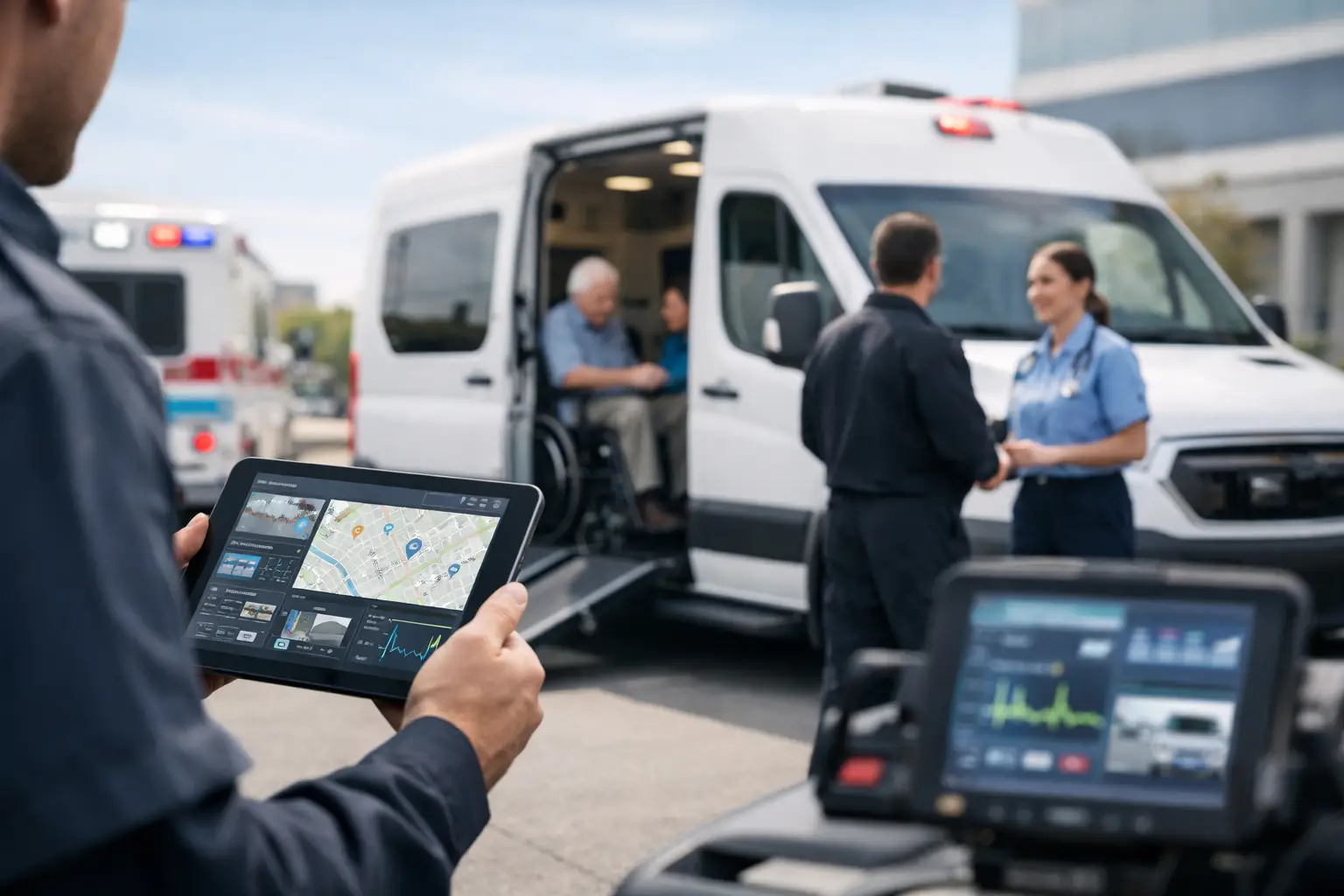
A missed pickup is rarely caused by a single dispatch error. More often, it is the visible result of disconnected scheduling, vehicle availability, driver communication, trip documentation, and billing workflows. Medical fleet technology integration brings those operating functions into a coordinated environment so leaders can manage service delivery with clearer control, stronger accountability, and better data.
For non-emergency medical transportation providers, the objective is not to add technology for its own sake. It is to build an operating model that protects patient access, supports drivers in the field, satisfies payer and regulatory requirements, and provides executives with dependable visibility across locations and divisions.
Why Medical Fleet Technology Integration Is an Operating Priority
NEMT operations have a higher coordination burden than many conventional passenger transportation models. A trip may involve recurring appointments, mobility requirements, facility discharge timing, authorization rules, wait-time limits, family communication, and return-trip uncertainty. Each variable affects vehicle assignment, driver capacity, on-time performance, and cost.
When critical systems operate separately, teams compensate with phone calls, spreadsheets, manual status updates, and individual institutional knowledge. That approach can work for a small operation with stable volume. It becomes less reliable as the fleet expands, service territory widens, or new contracts introduce different payer requirements.
An integrated technology environment creates a more consistent trip lifecycle. A scheduled ride, for example, can move from intake and eligibility review to dispatch, driver assignment, vehicle tracking, arrival confirmation, trip completion, and billing documentation without requiring teams to re-enter the same information across multiple systems. The benefit is not simply speed. It is a cleaner operational record that enables managers to identify exceptions before they become service failures.
For enterprise transportation organizations, integration also establishes a common operating language across divisions. Leadership can assess performance using defined metrics rather than relying on disconnected local reports. This is particularly valuable when managing multiple operating companies with different legacy processes.
Build Around the Trip Lifecycle, Not Individual Software Tools
Technology decisions are often made one platform at a time: a new routing application, a separate telematics system, a driver app, or an upgraded billing tool. Each may solve a legitimate issue. But a collection of strong point solutions can still create friction if the systems do not exchange accurate information at the right time.
The starting point should be the full trip lifecycle and the decisions made within it. At intake, the organization needs accurate rider profiles, pickup and drop-off details, required assistance levels, recurring ride patterns, and funding or authorization information. During planning, dispatch requires visibility into vehicle capacity, driver qualifications, route constraints, and expected trip duration. In the field, operators need live location data, reliable status updates, and a defined escalation process for delays or no-shows.
After the trip, the organization needs defensible completion records, exception details, and billing-ready data. If a driver records a passenger pickup in one application but that status does not update dispatch or the billing workflow, the operation is still dependent on manual reconciliation. The technology may be modern, but the process is not integrated.
Define the System of Record
A scalable environment requires clarity about where each type of data originates and which system owns it. The scheduling platform may be the system of record for trip details. A fleet platform may own vehicle diagnostics and location history. A human resources or credentialing system may govern driver eligibility. Financial systems may hold final billing and payment records.
The goal is not to force every function into one application. It is to establish controlled data movement between systems, with clear ownership and validation rules. Without that discipline, duplicate rider profiles, conflicting trip statuses, and inconsistent driver records accumulate quickly.
This distinction matters during growth. A local operator can often resolve inconsistencies through direct communication between a dispatcher and a manager. A multi-location organization cannot depend on informal correction as its primary control mechanism.
Connect Field Data to Dispatch Decisions
Vehicle location data is useful only when it changes an operational decision. GPS tracking, electronic driver vehicle inspection reports, engine alerts, fuel data, and driver app activity should inform dispatch and maintenance teams in practical ways.
For dispatch, this may mean recognizing that a vehicle assigned to a high-priority discharge trip is delayed beyond an acceptable threshold and reassigning the trip before the facility calls. For maintenance, it may mean removing a vehicle from future assignments when diagnostic information indicates an emerging issue. For safety leaders, it may mean reviewing patterns in speeding, harsh braking, or extended idling alongside route and scheduling conditions.
Real-time visibility must be paired with operating protocols. A screen full of vehicle icons does not improve outcomes unless someone has responsibility for monitoring exceptions, authority to adjust assignments, and a defined process for communicating changes to drivers and riders.
There is also a trade-off. More granular data can improve oversight, but excessive alerts create noise and distract dispatch teams from meaningful events. Operators should configure thresholds around service-critical conditions, such as late arrivals, extended dwell time, vehicle faults, route deviation, or a driver failing to acknowledge a trip change.
Design for Compliance, Privacy, and Auditability
Medical transportation technology frequently handles sensitive rider information. Integration planning must therefore include privacy and security from the beginning, not as a later compliance review.
Organizations should apply the minimum necessary principle to rider data. Dispatchers need information required to arrange safe transportation. Drivers need information required to complete the trip appropriately. Maintenance personnel generally need vehicle information, not detailed rider records. Role-based access controls help limit exposure while giving each team the information needed to perform its function.
Auditability is equally important. A mature environment should preserve a reliable history of trip changes, assignment updates, driver acknowledgments, pickup and drop-off timestamps, cancellations, and exceptions. That history supports payer documentation, customer issue resolution, internal review, and operational improvement.
Integration partners and software vendors also require governance. Leadership should understand where data is stored, how it is transmitted, how long it is retained, and who can access it. Vendor evaluation should consider security controls, service continuity, application programming interface capabilities, reporting access, and the provider's ability to support changing operational requirements.
Standardize the Core, Preserve Local Expertise
Technology integration often becomes more complex during acquisitions or the consolidation of regional operations. Each company may have its own dispatch habits, payer mix, fleet composition, driver onboarding process, and preferred software. Immediate replacement of every local system can disrupt service and erode trust among experienced operating teams.
A better approach is to standardize the enterprise controls that should be consistent while assessing where local variation is justified. Safety requirements, driver credential standards, cybersecurity expectations, core performance metrics, and data governance should generally be enterprise-wide. Local teams may retain flexibility in areas shaped by geography, facility relationships, or contract-specific rules.
This model gives a transportation platform a practical path to integration. The business does not have to choose between total centralization and a collection of independent systems. It can establish shared digital infrastructure while retaining the operational specialization that made each regional company successful.
For owners considering an exit, this is more than a technology discussion. A business with documented processes, accessible performance data, and systems that can connect to a larger operating environment is easier to evaluate and transition. Technology maturity can reduce integration risk for both the seller and the acquiring organization.
Measure the Outcomes That Matter
Integration should be judged by operating outcomes, not by the number of platforms deployed. On-time pickup performance, completed-trip rate, cancellation patterns, no-show handling, cost per completed trip, vehicle utilization, preventable maintenance downtime, and billing cycle time provide a more meaningful picture.
The most valuable measures connect departments. If on-time performance declines, leaders should be able to determine whether the cause is scheduling density, late facility readiness, driver availability, vehicle downtime, routing assumptions, or a specific contract pattern. If claims are delayed, teams should be able to see whether missing trip documentation, authorization issues, or data-transfer failures are responsible.
This is where integrated reporting changes leadership capacity. Instead of asking each department to explain a separate version of events, executives can examine connected data and direct corrective action at the underlying constraint.
A Disciplined Path Forward
Technology integration does not require a large-scale, one-time replacement program. In many cases, the better sequence is to identify the most consequential data breaks, establish integration standards, improve a high-volume workflow, and expand from proven results. A recurring dialysis route, hospital discharge program, or high-utilization service zone can provide a focused environment for testing new workflows before broader deployment.
NextGen Mobility views advanced fleet systems as part of the operating infrastructure required to support specialized transportation at scale. The priority is disciplined execution: systems that strengthen safety, improve service reliability, and give operating leaders the information needed to make timely decisions.
The right next step is to map one actual patient trip from request through payment and ask where information is delayed, duplicated, or lost. That exercise often reveals the integration priorities that will have the greatest effect on the operation.